Donnerstag, 8. Oktober 2015

Mittwoch, 7. Oktober 2015
Medtech / Pharma Conference
Final Call for Registration – “Combined solutions for patients” 22-23 October, Zurich
The second international Medtech & Pharma Platform conference focusing on combination products development is almost at our door. If you have not yet registered for the two-day event or the networking dinner, please consider registering now online save time on site. New to the meeting format is 1-on-1 partnering (see below for more details).
I don’t want you miss this great opportunity to connect with international regulatory, patient advocacy, and industry experts and profit professionally from this exceptional program. Download the full program here.
Notable speakers and topics include:
- Jill Hartzler Warner, FDA’s Associate Commissioner, will present the Division’s current thinking on pathways for innovation
- Swati Baht, MHRA, Clinical Assessor, will discuss the key clinical aspects required in a submission
- Thomas Kühler, Novo Nordisk, will examine the patient voice in benefit-risk assessments
- Edith Hantak, Baxalta, will moderate an intense session looking at industry clinical development strategies and trends as well as regulator and notified body perspectives.
- Nicola Bedlington, European Patient Forum, will be the Keynote Speaker
1-on-1 partnering
Business-to-business contacts and mutual cooperation can pave the way for bringing products to market more efficiently. With your registration you receive an opportunity to present your business in 1-on-1 meetings to senior management of attending companies. In your profile you can state what kind of expertise you are offering, what kind of cooperation you are looking for, and which ideas you would like to discuss with potential collaboration partners. This exclusive “matchmaking” event at this conference aims to break the ice and get your company and ideas in front of your peers with minimal constraints.
Click here to browse through our database of current registered participants.
Please do not hesitate to contact me should you have any questions regarding the registration process or any part of the meeting organization.
I am looking forward to your registration and to welcoming you in Zurich.
Medtech / Pharma Conference
Montag, 5. Oktober 2015
In-The-Cloud LIMS: A TCO Analysis
There is growing demand for a standardized and economical LIMS (Laboratory Information Management System) architecture in the life sciences industry due to global R&D operations, lack of budgets, stringency of regulatory bodies towards data integrity, and the need for compatible platforms for sharing knowledge/data within the organization and third parties (contract research and manufacturing organizations (CROs and CMOs)). Different companies have adopted different strategies to mitigate their respective challenges in the field of laboratory data management. SAAS based or In-the-cloud LIMS offers a standardized way to help commercial and academic institutions in managing their laboratory data across the globe. Lack of investment in hardware and a high degree of scalability makes Software as a Service-based (SAAS) architecture to be among the most efficient platform to implement global and standardized LIMS. We analyze the Total Cost of Ownership (TCO) of the SAAS- based or ‘In-the-cloud’ LIMS to understand its applicability as a standardized and cost effective solution to the current laboratory data management challenges faced by the life sciences industry.
Introduction
IT infrastructure plays a crucial role in the success of any organization. Across industries, companies use various types of IT enablers to manage their data. LIMS is one of the most widely used IT platforms in various laboratories across industries. LIMS is used to manage laboratory data generated from different laboratory functions including, but not limited to, sample testing, instrument usage, automation, and report generation. As per industry estimates, LIMS market is valued at around $1 billion in 2015 and is expected to grow at an estimate CAGR of 8 percent until 2019.
In recent years, LIMS has become more critical, especially for the life sciences industry, and is driven by the following factors:
- Increased and continuous inflow of data from clinical and medical laboratories across the globe.
- Advancements in the area of proteomics and genomics and the inclination of the pharmaceutical industry towards personalized medicine and rare disease treatments.
- Adoption of big data and growing demand for better data mining techniques.
- Developing markets – India, China, and Eastern Europe; are pressing hard for automation, hence creating increased demand for LIMS.
On the contrary, the life sciences industry is facing new challenges in managing laboratory data. Firstly, Global R&D operations of pharmaceutical companies – which include their captive sites and different research (CROs) and manufacturing (CMOs) partners, require LIMS to deliver a suitable platform for sharing, collection, storage and retrieval in compatible format across the functions of different laboratories. Secondly, downturn in economies has reduced financial resources for pharmaceutical companies. With these limitations, laboratories would shift their data management to a global and standardized architecture. Given this scenario, In-the-cloud LIMS could offer a standardized global architecture with optimum cost benefits.
In-the-cloud LIMS Vs. Others
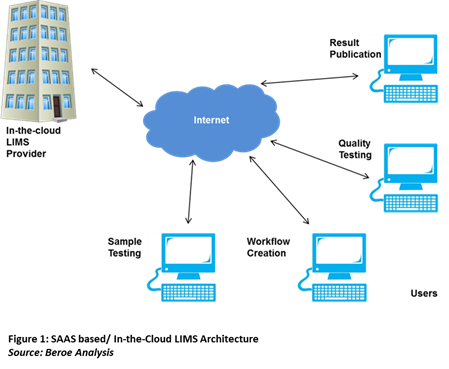
In-the-cloud LIMS is an SAAS-based IT platform to manage laboratory data generated from different laboratory functions such as sample testing, instrument usage, automation, and report generation (Figure 1). SAAS is an on-demand software delivery model where users subscribe the software and access it through a web browser. The provider hosts the software centrally and offers it to the user on the pay-for-use basis1.
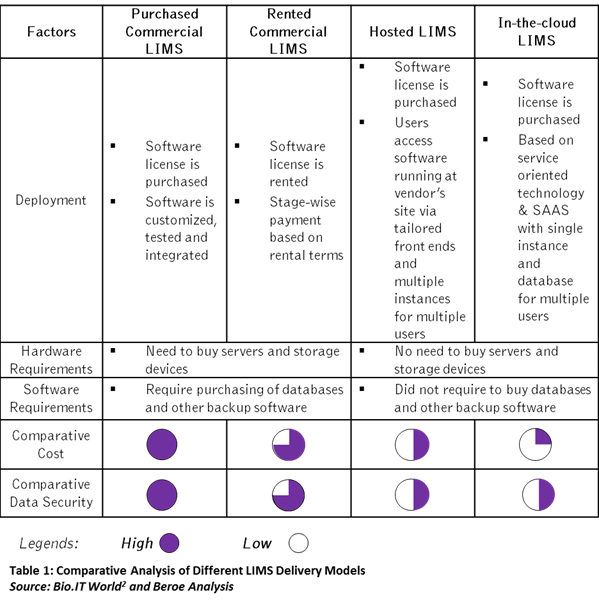
Vendors deliver LIMS in various forms based on a user’s requirement. Based on delivery mode, LIMS can be categorized into four types: Purchased Commercial LIMS, Rented Commercial LIMS, Hosted LIMS, and In-the-cloud LIMS. Each type is different in terms of their architecture, deployment method, and requirement for hardware and software support2. This eventually impacts the cost of the LIMS. The supply market of SAAS based LIMS is less crowded as compared to the other types of LIMS. According to Beroe’s findings, around 300+ LIMS vendors are present in the market with greater than 15 percent offering cloud-based LIMS. Table 1 below lists the differences among different types of LIMS.
In-the-cloud LIMS – TCO Analysis
Every sourcing activity is carried out after a thorough understanding of the supply market and the respective cost components of the product or service. Mostly these decisions are derived by analyzing the total cost of ownership (TCO) involved in delivering the service. In Table 1, it could be assumed that In-the-cloud LIMS would offer direct cost savings as the user does not have to invest on IT infrastructure. However, a few primary questions remain unanswered, such as:
- Are the cost savings sustainable in the long run?
- Who will be paying for software maintenance?
- What are the expected cost savings in the long run with In-the-cloud LIMS?
Based on our understanding, the usage period of LIMS software in an organization is around eight to 10 years. To get more clarity on the cost benefits of In-the-cloud LIMS in the long run, we compared its cost with that of purchased LIMS for 10 years of usage. We arrived at the cost analysis as shown in Table 2 below.
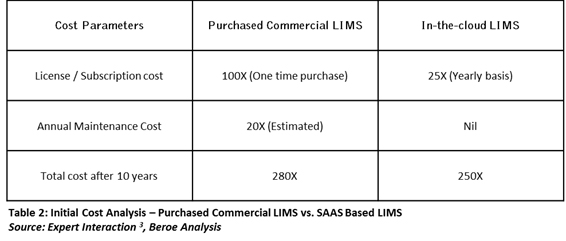
In the above analysis, the maintenance cost of purchased commercial LIMS during the first year is not included as it is free for buyers. For the subsequent years, the annual maintenance cost is around 20 percent of the initial license cost. For better understanding of the difference in total cost of ownership, we assume the yearly subscription fees of SaaS-based LIMS is as high as ~25 percent of the initial purchased cost of the commercial LIMS.
According to the above analysis, for company ‘A,’ we assume that the one time license cost of the commercial LIMS is $50,000. Due to best-in-class maintenance practices, the annual maintenance cost is around 15 percent of the license cost i.e. $7,500. Then the total cost of purchase after 10 years is $117,500. Now, if company ‘B’ purchases the yearly subscription of SaaS-based LIMS at $12,500, then the total cost of purchasing SaaS-based LIMS for 10 years is $125,000. This would reap a loss of around $7,500 to company ‘B’ during 10 years. However, in case the usage is eight years, there are possibilities for company ‘B’ to get the benefits of direct cost savings due to the absence of hardware, operating system, and database costs. Also, the risk for company ‘B’ is reduced as upfront investment is less in comparison to the purchased LIMS and switching to other suppliers in case of any constraint.
The total cost of ownership analysis goes beyond the purchase cost and must include the money and efforts spent on managing internal IT infrastructure. In that case, we would find the real benefits of SaaS-based LIMS. Table 3 below shows the hidden costs of a purchased commercial LIMS.
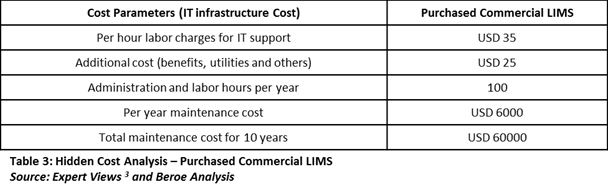
Note: Maintenance hours and charges are subject to many factors such as location and the complexity of issue.
When including the IT infrastructure maintenance cost with the initial cost, the equation changes dramatically in support of cloud-based LIMS. If we include the internal IT infrastructure cost to the analysis of the purchase carried out by companies ‘A’ and ‘B’, then company ‘B’ would earn cost benefits of more than $50,000 over 10 years.
Conclusion
Based on the analysis presented in table 2 and 3, it can be concluded that In-the-Cloud LIMS offers an economical and standardized solution to the laboratory data management needs of big pharma as well as small laboratories of CROs, CMOs, and academia in both developed and developing regions. The purchased commercial LIMS requires more personnel assistance and monetary support for maintenance and other functions such as backup, storage, and recovery as compared to SAAS-based LIMS. Harmonization with the existing systems and data security are the main concerns restraining the users from adopting SAAS-based LIMS. In the near future, these concerns would be mitigated with increased adoption of SAAS-based LIMS as a result of advancement in technology.
http://www.clinicalleader.com/doc/in-the-cloud-lims-a-tco-analysis-0001
In-The-Cloud LIMS: A TCO Analysis
Dienstag, 29. September 2015
Delivering Custom Lab Automation Projects
Automation by Design
In today’s fast paced and ever evolving world of drug discovery and development, it is essential that investigative processes run as efficiently as possible. As current patents are expiring and regulatory requirements become stricter, the need for an increase in the number of quality potential drug compounds is high. By streamlining R&D processes through automation, research facilities could see a significant benefit in terms of time and cost, something which could be imperative to the timely development of new drugs to the market.
As a result of this need for highly streamlined processes, automation has become commonplace across the vast majority of research facilities within pharma and biotech. However, there has been a drive to change and further optimise workflows while decreasing associated costs, and with this has come a variety of new challenges that need to be met. Efficient, but cost-effective, future proofed automation solutions have over recent years become a requirement. As R&D processes evolve and become inherently different from one facility to the next, a customised automation solution may be the answer. By tailoring a bespoke automation system to meet the exact needs of each facility, efficiency and thus, productivity can be further increased. While users can be confident in the performance of the system, their time is also freed-up, allowing them to dedicate more resource to other projects.
Although the need for customised automation has remained reasonably stable, the amount of customisation being undertaken in-house has decreased. The shift towards using third party organisations for the development and customisation of automated solutions is indicative of the increasing need to outsource. It has been predicted that the monetary value pharmaceutical companies dedicate to outsourcing such tasks will almost double from figures seen in 2009 to that forecast in 201. This shift emphasises the importance of being able to tap into a source of expertise and a diverse skill set to enable to the development of a high quality end product. The externalization of such functions, particularly within R&D, has gained an increased level of importance in the pharmaceutical industry.

Visit http://www.astechprojects.co.uk/ for more information!
Delivering Custom Lab Automation Projects
Samstag, 26. September 2015
HowTo construct a integratable device for a robotic platform?
There are a lot of peripheral devices for pipetting robots and all of them have a few things in common. In this post, I want to list a few of them, without going to much into detail. I know this is a huge field, and there are different ways of looking onto this topic. I`ll try my best...
Size matters:
A shoe box is always better than a moving box. If you need more space, build your device in the height rather than to block the whole worktable.
Size does not matter:
If your device is too big to be inside of a robot anyway, make it reachable for an internal gripping arm. This can be a great help if you don`t want someone to waste money for a separate robotic arm or labware transport.
Accessibility:
Most of the time your device will do things inside or outside of your robot, you know. Make sure it`s usable with different labware type like Microtiter Plates from different suppliers (calculate some buffer). Have the device accessible for the transporting arm and make sure the labware is aligned the same way every time the labware gets unloaded from the device.
Stability overall:
Make your device easily mountable to the worktable. Once positioned it should not be able to be moved. Millimeters can screw things up in worst-case.
Interface / Software / Firmware / Drivers / Server:
I am not going to write a lot about software because this topic could fill a book I guess. But connectivity is most important at this point. The device must be reachable for the main control software at any time. Nothing makes your day after a connectivity problem which caused unacceptable trouble. SILA is a good invention and soon it is going to be better hopefully. Plug and Play would be great.
LEDs:
And don`t forget the LEDs, as no one will buy your product without these anymore
A few things besides:
- Cable positioning
- Connection indicators
- Easy servicing
- Parameters tracking
- Who knows more?
HowTo construct a integratable device for a robotic platform?
Montag, 21. September 2015
Next Gen Sequencing and Tecan`s basement
Tecan is a market leader in lab robotics, builds swiss quality pipetting stations (and more) and always complies with the wish of their customers! High-Tech is what`s inside of their products and people are aware of this fact!
But the most important, unsolved question about this company is: What`s in Tecan`s basement?
There are few rumours about this one, but nothing was approved officially:
- A candy shop
- A refugees camp
- Iron Man`s personal fitness studio
- A swiss bunker basement
But let`s stop kidding for a moment see the recent invention of Tecan:
NGS sample preparation

Next generation sequencing (NGS) technology is advancing at an unprecedented speed. The ever increasing throughput of NGS instruments, combined with the option to multiplex more and more samples, means that sample preparation has become a bottleneck in many laboratories.
Automation of NGS sample preparation on the Tecan Freedom EVO® NGS workstation increases throughput and reproducibility, guiding the user through each step of protocol selection and worktable set-up with the TouchTools™ operator interface.
Working in collaboration with key research centers and NGS sample preparation kit vendors (including Illumina® , Kapa Biosystems and Thermo Fisher Scientific), Tecan has developed and optimized automated NGS sample preparation protocols which have been tested and verified to ensure excellent performance in any laboratory.
If you want to know more about this topic, just hit the link and read the same things (+ a bit more) at Tecan`s Website
Just tell us in the comments, what YOU think is in Tecan`s basement... 
Next Gen Sequencing and Tecan`s basement
Mittwoch, 16. September 2015
Submit articles to our blog!
As you may know, our LabAutomations Blog outranks high competition keywords every time something is posted. There is no magic behind, just a bit of work, good content and an automated syndication network. OK, to be honest there are a few tricks and special things about the way posts are released, but this is another story...
But I was told I can post on this blog too??
Yes, everyone can! You just need an account at LabAutomations and something to post about...!
Here is the URL: https://labautomations.com/blog-submission/
There are a few rules, but nothing special:
- Content has 300+ words
- Content is on topic
Submit articles to our blog!
Abonnieren
Posts (Atom)